Prices
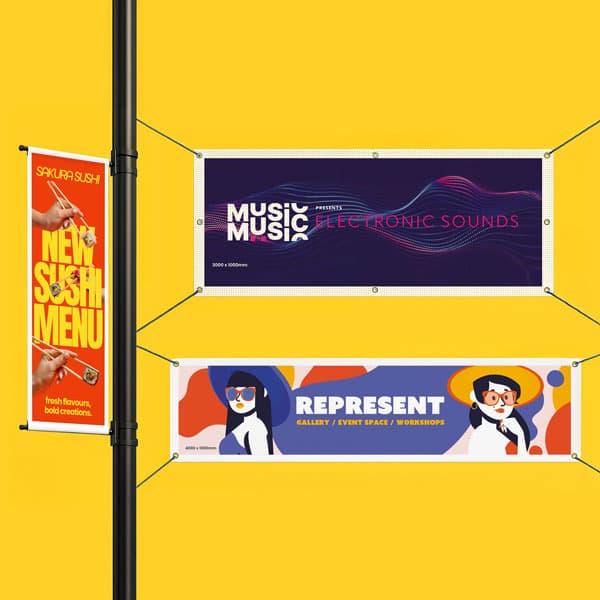
Outdoor banners look simple: Design it. Print it. Hang it up. Done.
But anyone who has actually used them knows it is never that straightforward. Banners are an advertising tool that has to communicate instantly, survive exposure, and remain effective in changing environments.
Most issues don’t come from the print itself. They come from decisions made before and after production—design, installation, placement, and expectations. These outdoor banner do’s and don’ts will help your banner stay visible, stay secure, and perform for longer.
Most banner designs are created too close: zoomed in on a screen and treated like a poster. The issue with that is most outdoor banners are not experienced that way.
They are seen in motion, at a distance, and often while people are distracted. At that point, people don’t read banners. They recognise them. Design becomes less about detail and more about instant clarity.
At distance, the brain reduces everything to:
If a message takes time to decode, it gets ignored. That’s why effective banners rely on:
Not because simplicity is safe, but because it works under real conditions.
A common misconception is that banners are all the same material with different designs printed on top.
They are not. The material affects how a banner behaves once it is installed and exposed.
A sheltered shopfront banner and an exposed roadside banner will face completely different conditions, even if they look identical at the design stage.
Same print. Same design. Different environment. That difference affects durability, appearance, and lifespan. Choosing the right banner is not an upgrade decision. It is about matching the product to the environment it will actually live in.
A common mistake is assuming installation is simple: just hang it up and it’s done.
But once installed, a banner is no longer a flat printed sheet. It becomes a fixed surface held from its edges, working as part of a physical structure.
That means installation directly affects performance. Poor installation does not usually cause immediate failure. It creates uneven stress that builds over time along the edges.
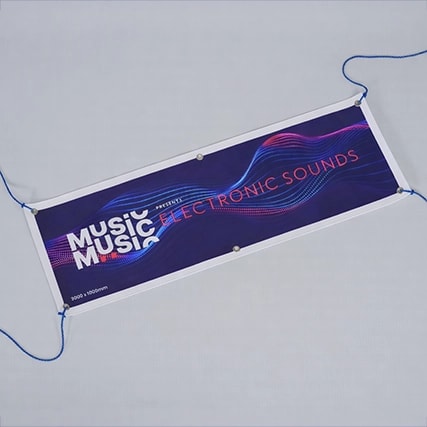
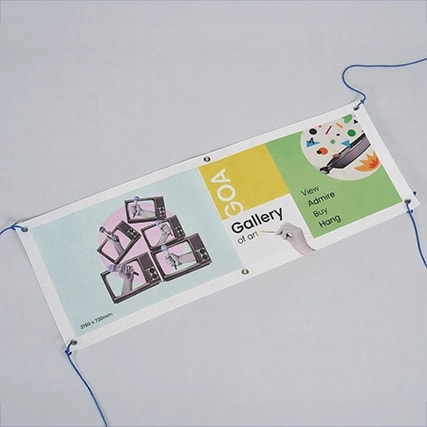
Eyelets are an optional feature of outdoor banners but they allow the banner to be securely fixed in place.
Their role is simple: support the banner along its edges so it hangs correctly and stays in position.
They also help spread the load across the banner instead of concentrating it in one area. This matters because banners are almost always secured from the edges, where pressure naturally builds. That is why wear often appears at the corners first. Not because the print is weak, but because that is where stress accumulates over time.
Different banner sizes need different levels of support.
It is not about technical detail.
It is about making sure the banner is properly supported in real-world conditions.
If you are unsure how many eyelets your banner needs or how spacing should change depending on size and installation, our eyelets guide explains the recommended setups in more detail.
One of the biggest disconnects in banner design happens when artwork is created entirely in a digital environment.
What looks balanced on a monitor doesn’t always translate to real-world scale. At size and distance:
A banner has to work in its environment, not just in the file it was created in. That means designing for scale, distance, and speed of viewing, not close inspection.
Outdoor banners don’t fail in a single moment. They change gradually over time due to exposure.
Sunlight, weather, and placement all influence how long a banner stays effective.
UV exposure can reduce colour vibrancy over time, while repeated environmental changes slowly affect the material and edges. This doesn’t usually cause sudden failure. It causes gradual decline in appearance and readability.
Two identical banners can perform very differently depending on where they are installed.
Same product. Different lifespan. That is why placement should always be considered as part of the decision, not after it.
Outdoor banners are used for different purposes:
Each use case has different expectations.
A banner designed for a short event doesn’t need the same long-term durability considerations as one intended to remain installed for months.
Thinking about lifespan early helps ensure the right material, placement, and setup are chosen from the start.
Outdoor banners don’t fail because of one mistake.
They fail because multiple small decisions build on each other:
When those elements are aligned, banners become one of the most effective and straightforward forms of outdoor advertising.
Not because they are simple. But because they are predictable when set up correctly.
A quick summary of what matters most:
Outdoor banners work best when they are treated as physical objects in real environments — not just designs on a screen. Once you account for how they are seen, installed, and exposed, they become a highly effective and reliable advertising format.
Explore our outdoor banner printing options to get started. And if you want to make sure your installation is set up correctly, our eyelets guide explains how support and spacing can improve long-term performance.
Posted on July 1, 2026 by Emma Thompson
Related topics: