Prices
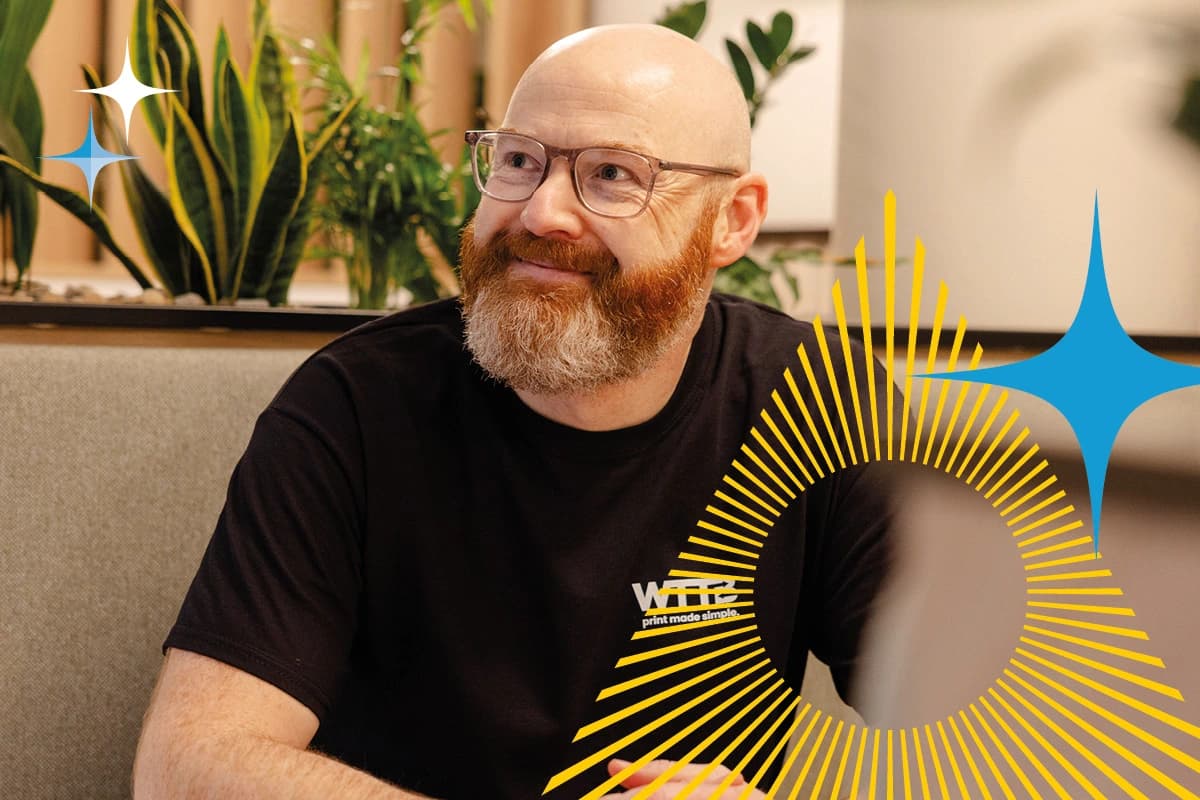
Most people in print fix what’s right in front of them. Michael fixes the things underneath - the structures, the logic, the flow - the foundations that decide whether everything else works or falls apart.
He’s been with WTTB since the beginning, long before the platform looked anything like it does today. Eleven years in, he’s still shaping the way it runs, not by adding polish, but by rebuilding the engine that drives every customer touchpoint. His path to Production Director wasn’t traditional; it was layered. Artworker. Pre-press. Account manager. CMS lead. Project manager. Each step gave him a different angle on how print actually works, and more importantly, where it breaks.
That mix of craft, pressure and problem-solving shaped the way he leads now. Michael doesn’t think in silos. He thinks in systems. He sees how one small friction point in ordering can ripple into production; how a missed expectation in customer service becomes an operational challenge downstream; how one wrong assumption in development can derail an entire workflow.
And that’s where he operates - in the friction between teams, guiding developers, production, product, marketing and ops so they move with purpose instead of noise. He doesn’t hover or micromanage. He sets direction, offers context, removes bottlenecks, and then lets specialists get on with what they do best. It’s leadership through alignment, not volume.
When the new WTTB site launched this year, Michael felt the same thing many customers did: it wasn’t as far along as anyone had hoped. Not because of a lack of effort, but because the complexity of the real world revealed itself only once people started using it. Lesser leaders hide moments like that; Michael doesn’t. He tore into the problems, reorganised priorities, reset expectations, rebuilt what needed rebuilding, and drove the changes that have made the platform far more stable, faster, clearer and more predictable today. That’s how he works. Quietly, methodically, and always forward.
He treats WTTB like a living system: when something strains, he reinforces it; when a part slows, he redesigns it; when something works, he strengthens it further. He isn’t interested in theory, only in what actually makes the experience better for customers and cleaner for the teams producing their work.
Most customers will never know the specifics of what he’s fixed, they’ll just feel the result.
A smoother order path. Fewer surprises mid-production. Cleaner product setup. Snags solved before they become phone calls. A platform that behaves the same way on Monday morning as it does in peak season.
That reliability isn’t an accident.
It’s the output of someone who notices the strain before it becomes a crack.
“Innovation and automation only matter if they make ordering easier. That’s the point: build a process customers can trust, every time.” — Michael Elder
He focuses on the weak spots most people never see and strengthens them before they become problems. That’s his rhythm: find the strain, fix the structure, lift the whole system. That’s his magic.
Not dramatic. Not noisy. Just solid, scalable work that holds WTTB together when it matters.
What’s one improvement you’ve made in your own work that no one sees, but makes everything run better?
Posted on January 8, 2026 by Emma Thompson
Related topics: