Prices
Outdoor signage has to do more than look good on a screen. It needs to suit its location, remain readable from the expected distance and withstand the conditions it will encounter. A pavement sign outside a café has different requirements from a banner attached to fencing, a directional board at a construction site or a long lasting sign fixed to a building.
The most effective outdoor signs are planned around where they will be seen and how quickly the audience needs to understand them.
This guide explains how to choose a suitable format, compare outdoor signage materials, design for real viewing conditions and prepare your signs for secure installation.
Outdoor signage covers a wide range of printed products used to promote, direct, identify or inform.
Common examples include:
Some are designed for temporary campaigns, while others may remain in position for months or years. This expected lifespan should be established before deciding on a material or finishing option.
The location should guide every major decision about an outdoor sign.
Before choosing a product, consider:
A banner across a car park needs a larger and simpler message than a pavement sign outside a shop. A board attached to a fence will encounter different conditions from a poster placed inside a covered frame.
Choosing the location first prevents you from selecting a material that cannot be installed securely or a design that cannot be read in time.
Different formats solve different communication and installation problems.
What you need | Suitable format |
|---|---|
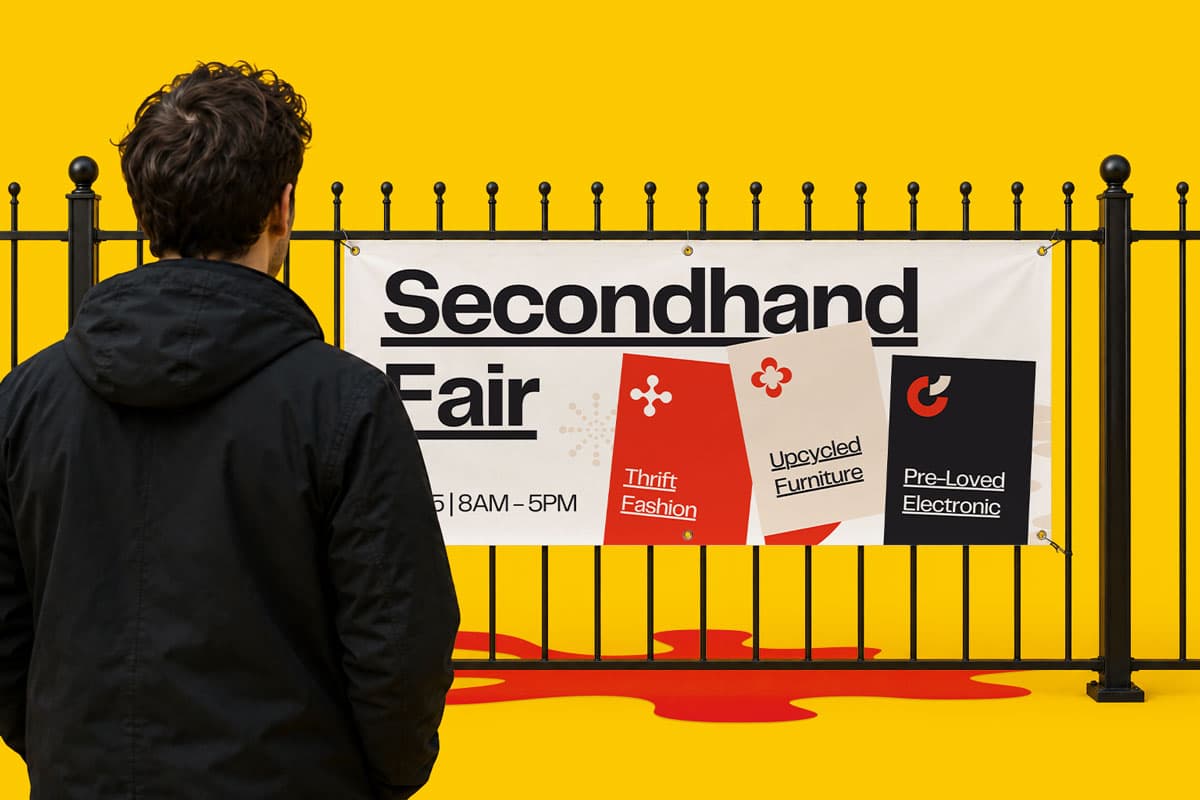
A large promotional message on a wall or fence | |
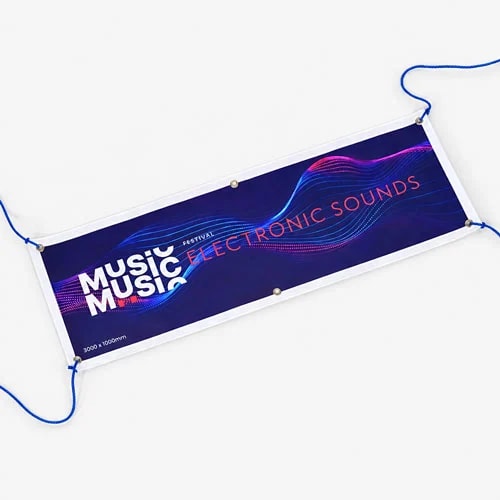
A banner for a more exposed position | |
A lightweight temporary directional or property sign | |
A rigid sign for longer use | Aluminium Board |
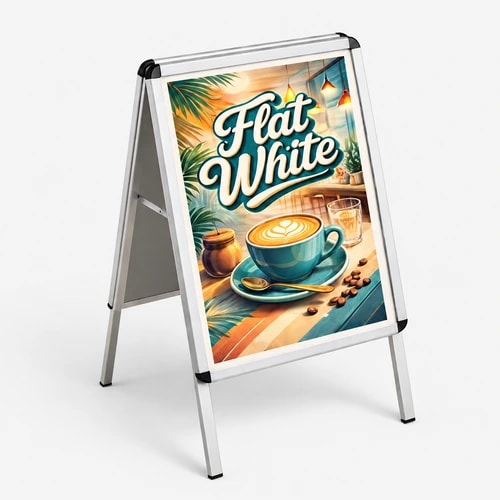
A promotion displayed outside a shop | Pavement Sign or A frame |
Branding or an offer applied to a suitable window | Self Adhesive Vinyl |
Visibility above a crowd or surrounding display | |
A temporary message inside a suitable outdoor poster frame |
These are starting points rather than universal rules. The exact material should always be checked against the location, installation method and expected period of use.
Our Display and Signage range brings together formats for walls, fences, pavements, windows, retail spaces and events.
PVC and mesh banners can both carry large messages, but they behave differently outdoors.
PVC is a solid, waterproof banner material suited to many general outdoor promotions. It can be used across shopfronts, walls, fencing and temporary displays where a large, continuous printed surface is required.
Because it is solid, PVC provides strong colour and image coverage. However, that solid surface also catches more wind.
The location and fixing method therefore matter. A PVC banner placed in a highly exposed position may experience much more pressure than one attached to a sheltered wall.
Mesh contains small perforations that allow more air to pass through the material. This can reduce wind pressure, making it more appropriate for exposed fencing, scaffolding and other open locations.
The perforated surface means that colour and fine detail may appear slightly less dense than they would on solid PVC. Designs should therefore use clear shapes, strong contrast and sufficiently large text.
Mesh reduces wind resistance, but it does not remove the need for secure installation. The banner must still be fitted using suitable fixing points and inspected during poor weather.
Rigid boards are available in several materials, each with different strengths.
Correx is a lightweight fluted plastic board commonly used for temporary signs.
It can suit:
Its low weight makes it easier to handle and attach to suitable frames or posts. The fluted construction is useful for temporary applications, but it does not provide the same rigidity or finished appearance as a heavier board.
Correx is a practical choice when portability, quantity and shorter campaign use are more important than a premium permanent finish.
Foamex is a smooth PVC foam board that produces a clean printed surface.
It is widely used for retail graphics, exhibitions and internal displays. It can be used in some external settings, but the specification, thickness, fixing method and expected exposure should all be considered.
Foamex should not automatically be treated as the default outdoor board. For exposed or longer lasting signage, another rigid material may be more appropriate.
Aluminium composite board combines aluminium faces with a lightweight core. It provides greater rigidity and durability than Correx, making it suitable for longer lasting signs, property branding and commercial displays.
It can be fixed to suitable walls, posts or sign systems, depending on the product and installation.
Its rigidity does not make the installation method optional. The supporting surface, fixing positions and wind exposure still need to be assessed before the sign is ordered.
Use the WTTB Print Materials Hub to compare display options available and understand their typical applications.
Outdoor artwork should be judged at the distance from which it will actually be read.
A design may look spacious and clear when it fills a laptop screen but become difficult to understand when viewed across a road, car park or event space.
Begin with one question:
What is the single most important thing the audience needs to understand?
That could be:
Give that message visual priority. Supporting information should remain secondary and should not compete with the main purpose of the sign.
Pavement signs and window graphics viewed by pedestrians can carry a short headline, supporting detail and a clear action.
Shopfront banners and property boards need larger text, fewer details and a stronger visual hierarchy.
Signs viewed across open spaces or from moving vehicles need very little copy. A brand name, short message and clear direction may be all the audience has time to process.
There is no universal word limit for outdoor signs. The correct amount depends on the distance, audience movement and time available.
Legibility is more important than decorative detail when the audience only has a few seconds to look.
Choose a typeface with open letterforms and enough weight to remain clear at the intended size. Avoid using thin strokes, tightly condensed lettering or decorative fonts for essential information.
The design should also include:
Do not rely on colour difference alone where contrast is weak. Yellow text on white or dark red text on black may be technically visible but difficult to read outdoors.
Review the artwork at a reduced scale and from across the room. This will not reproduce the exact outdoor distance, but it can quickly reveal whether the main message is being lost.
An image can help explain a product, service or destination, but it should not overpower the message.
Choose images with:
A detailed photograph that works in a brochure may become visual noise on a roadside banner. Simpler compositions and closer crops are often more effective at larger scales.
Where an image is mainly decorative, ask whether the space would work harder with a larger headline or clearer direction.
A sign seen by pedestrians can contain more information because people may stop, move closer or return to it.
A sign aimed at drivers must be understood much faster. It should avoid detailed copy, small web addresses and instructions that require prolonged attention.
Do not place QR codes on signage intended to be scanned by someone who is driving. Use a memorable web address, clear destination or simple directional message instead.
QR codes may be useful on pavement signs, posters and displays where people can stop safely. They should be large enough for the expected scanning distance and surrounded by clear empty space.
Always test the code from a printed proof or correctly sized test before production.
A sign is only as effective as the method used to display it.
Do not wait until the printed product arrives before deciding how it will be installed. The artwork, dimensions and finishing options may all depend on the support structure.
Check whether the banner will be attached to a wall, fence, frame or temporary structure.
Eyelets need to correspond with suitable fixing positions. The banner should be supported evenly rather than pulled tightly from only a few points.
Overtensioning can place unnecessary pressure on the eyelets and edges. Loose installation can allow the banner to move excessively in the wind.
Use fixings suited to the supporting structure and inspect outdoor banners regularly for movement, loosening or damage.
Boards may need drilled holes, posts, frames, rails or another supporting system.
Confirm the position of fixings before placing important text, logos or borders near the edge of the artwork.
Large boards may require professional installation, particularly when they are mounted above ground level or in exposed areas.
Portable signs should stand securely on the intended surface and remain stable during normal use.
Follow the instructions for any weighted bases or poster frames. Bring portable signs indoors during severe weather or when they are no longer being supervised.
Use a base suited to the ground and location. Ground spikes, weighted bases and vehicle bases are designed for different environments and should not be treated as interchangeable.
Do not use a portable base simply because it is the easiest option to transport. It must also provide suitable support for the surface and conditions.
Outdoor signs and advertisements may require consent depending on their type, size and location.
Government guidance explains that signs must have the permission of the site owner. This includes the relevant highway authority where a sign is placed on highway land. Advertisements must not obscure official signs or create a hazard for road, rail, waterway or aircraft users.
Some signs have deemed consent, while others require an application. The rules can also differ across local authorities and between the nations of the UK.
Before installation:
Local councils can apply their own policies to A boards and other pavement displays. Requirements may cover position, stability, dimensions, removal times and the width of clear pavement that must remain available.
Once the sign has attracted attention, the audience needs to know what to do next.
Useful actions include:
Use one primary action rather than giving the reader several competing options.
A banner containing a phone number, web address, QR code, social media handle and physical address may provide plenty of routes, but it also makes each one harder to notice.
Choose the action that best matches the location and the way the audience will encounter the sign.
Outdoor signage rarely needs to work alone. A shop promotion could begin with an A frame outside, continue through window graphics and finish with leaflets or counter cards inside. A property campaign may use boards for visibility and printed brochures for detailed information. An event may combine banners, flags, directional signs and handouts.
Keep the visual identity consistent across each format, but adapt the amount of information to the product.
The banner should not become a brochure enlarged to several metres. Use outdoor signage to attract attention and direct people towards the next stage of the campaign.
Outdoor signage is easier to improve when the response can be connected to a particular location or message.
Possible measurement methods include:
Record where the sign was placed, how long it remained there and which message it used.
This allows you to compare performance rather than assuming every location, format or offer worked equally well.
Scan and response data should also be interpreted carefully. A sign may help with brand recognition even when someone does not act immediately, but measurable actions still provide useful evidence for future campaigns.
Outdoor products should be checked throughout their use rather than installed and forgotten.
Clean surfaces using a method appropriate for the material. Inspect fixings, eyelets, frames and bases for movement or damage.
Remove temporary signs when the campaign ends. Outdated dates, offers and directions can confuse customers and weaken trust in the surrounding display.
When storing reusable products:
Good storage can prevent avoidable damage and make existing display equipment easier to reuse.
Successful outdoor signage starts with understanding where it will be seen. Viewing distance, audience movement, weather exposure, expected lifespan and installation method should all influence the format, material and design.
When those decisions work together, the result is easier to read, safer to display and better suited to the campaign. It also reduces the risk of choosing a sign that looks right in the artwork but performs poorly once it is installed.
Explore our Display and Signage range to compare outdoor banners, display boards, pavement signs, flags and other formats for retail, hospitality, property, construction and events. Each product page explains the available sizes, materials and finishing options, while the Print Materials Hub helps you compare PVC, mesh, Correx, Foamex and aluminium composite board.
Once you have chosen your sign, use the Support Guides to prepare your artwork, set up bleed and colour correctly and supply a print ready PDF. You can also add an Artwork Technical Check for an extra review before production, helping you move from an initial idea to outdoor signage that is ready for its location.
Posted on May 28, 2025 by Miller Lane-Williams
Related topics:
£29.85

£17.85
£20.99
£38.46
£67.71