Prices
Election work can look straightforward at quote stage. A few thousand leaflets, some campaign signs and perhaps a banner or two. Then the versions start appearing.
Different areas need different contact details. One leaflet becomes several. Sign quantities change. A banner is added for an event. Some print needs to go to one address, some somewhere else, and the artwork for one format doesn’t translate cleanly to another.
That’s where election print becomes less about individual products and more about controlling the job as a whole.
If you already manage print for clients, none of the fundamentals are new. What makes election work different is the combination of fixed deadlines, multiple formats, localised artwork and compliance requirements that can all sit within the same campaign.
The most useful way to approach it is to build a structure around the campaign before the individual orders start multiplying.
A campaign containing five products isn’t necessarily five straightforward print jobs.
An A5 leaflet might have six local versions. Correx boards could use three designs across different quantities. Roller banners might all use the same core artwork but have different contact details. Everything may then need to reach several destinations. Looking only at the product list hides most of that complexity.
Instead, map each requirement across four things: the format, the artwork version, the quantity and the destination.
For example, a campaign might contain one core A5 leaflet design but four local variations. Each version could have a different quantity based on the area it covers. Posters might use the same artwork across the whole campaign, while signs have two versions and need splitting across different delivery addresses.
Once that structure is visible, it becomes much easier to understand how many actual files, specifications and deliveries sit behind the original brief.
A simple campaign control sheet can track:
That single view can be more useful than treating every product as an isolated order.
One of the easiest ways for election artwork to become difficult to manage is for every variation to turn into its own disconnected design. Where possible, establish what stays consistent and what changes.
The master artwork might contain the overall visual identity, typography, colours and common content. The variable elements might be the candidate name, local area, contact details, event information or imprint. That creates a much clearer version structure.
Instead of receiving files called FINAL.pdf, FINAL2.pdf and FINALNEW.pdf, you can build naming around the information that actually distinguishes each file.
Something like:
The naming convention itself doesn’t matter. What matters is being able to identify a file without opening it. That becomes increasingly important when the same campaign extends across leaflets, posters, signs and display products.
Where a WTTB product supports Versions, several artwork variations can also be ordered against the same specification rather than building every variation as a completely separate product order.
Versioning doesn’t just create more files. It can change the production logic behind the job. A request for 20,000 leaflets might initially look like one quantity. If it later becomes four designs at 5,000 each, it’s no longer necessarily the same production requirement or price.
The same applies when one artwork version suddenly needs a different stock, size or finish. That’s why it’s useful to establish the version structure before treating the combined campaign quantity as the basis for the quote.
It’s also worth remembering that a mixed election print order won’t necessarily have the same VAT treatment across every product.
HMRC currently lists qualifying leaflets, brochures and pamphlets among printed matter that can be zero rated, subject to the relevant conditions. Posters, postcards, stickers and badges are among products listed as standard rated.
For a campaign containing several different formats, it’s worth checking the VAT treatment at product level rather than assuming the whole quote will behave in the same way.
Most commercial print jobs have a required date. Election work has one particularly obvious difference: the event at the end of the process isn’t going to move because the artwork arrived late. That makes backwards planning more important.
Rather than treating the delivery date as the deadline, work backwards through the stages that need to happen before it.
The print needs to arrive before it’s required. That means production needs to finish before delivery. Production can’t begin until usable artwork has been supplied. Artwork can’t be supplied until the client has approved it. And if the material is being produced for a mailing scheme with its own approval process, another stage may sit before printing altogether.
The useful deadline is therefore rarely just one date. For a larger campaign, it can help to establish an artwork lock date for each group of materials rather than waiting for everything to be finished at once.
Leaflets needed for distribution may need to lock first. Event displays could follow later. Merchandise or supplementary signage might sit on a different schedule again. That gives individual parts of the campaign room to move without holding the entire job back.
Candidate Mail is worth identifying early because it isn’t simply an ordinary leaflet order with free postage added afterwards.
At certain elections, eligible candidates can be entitled to free postage for an election communication. Eligibility and the number of communications available depend on the election involved, so the Electoral Commission and Royal Mail should be checked for the current rules.
Royal Mail also has its own Candidate Mail process and artwork requirements. Campaign material needs to be submitted to Royal Mail for checking, alongside the appropriate Candidate Mail documentation. That approval stage sits before printing and can therefore affect the production schedule.
If a client tells you their leaflet is intended for Candidate Mail, establish that at the start of the job rather than once the print specification has already been finalised. The format, weight, artwork and presentation requirements can all matter.
It’s also worth keeping Candidate Mail separate from ordinary paid leaflet distribution. They’re different routes with different requirements and shouldn’t be treated as interchangeable services.
Election imprints introduce another responsibility that ordinary commercial print doesn’t usually have. Printed election material needs an imprint, but the exact requirements vary depending on who’s campaigning and the election involved. The Electoral Commission should remain the source for deciding what needs to appear.
From a production point of view, the useful thing is making sure responsibility for that content is clear.
Technical artwork checks can tell you whether a file is technically suitable for production. They can’t tell you whether the promoter details are legally correct, whether the appropriate person has been named or whether the imprint satisfies the rules that apply to that particular campaign.
That distinction is worth reflecting in the approval process. Rather than allowing imprint wording to become something assumed to have been checked by whoever last touched the PDF, make it an explicit client approval point.
The same applies to names, dates, contact information and any other campaign specific content. Our Election Imprints Explained guide goes into the current requirements in more detail, but final responsibility should always sit alongside the relevant Electoral Commission guidance.
A campaign often starts with one core piece of artwork and then expands. That doesn’t mean the A5 leaflet should simply be enlarged until it fits a poster. Different formats are viewed differently.
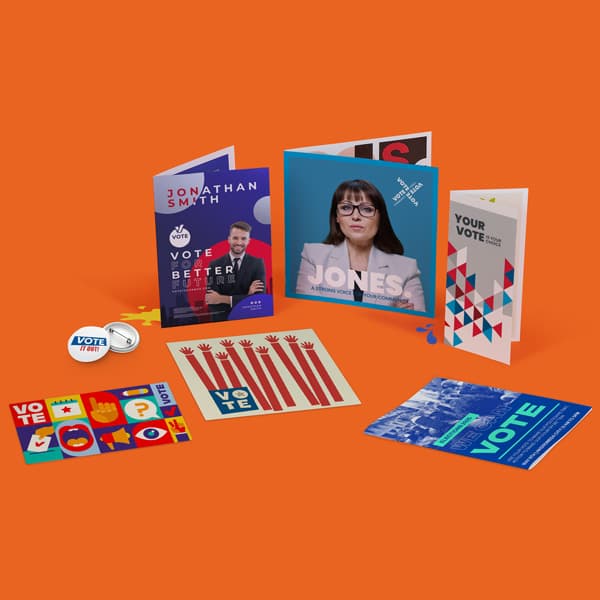
A leaflet is held close enough for smaller text and more detailed information. A Correx board may be read from across a street or entrance. A roller banner needs to work vertically and may only have a few seconds to communicate its information. A badge or pen has very little usable print area at all.
The visual identity can stay consistent without every format carrying identical content. A useful way to approach this is to treat the campaign artwork as a hierarchy. The smallest promotional formats might carry only the core identity.
Posters and signs can carry the information that needs to be understood quickly. Leaflets and booklets can handle the detailed content. That makes adaptation much cleaner than trying to preserve every element every time the dimensions change.
It also reduces the risk of receiving artwork where technically everything fits, but nothing works particularly well at the finished size.
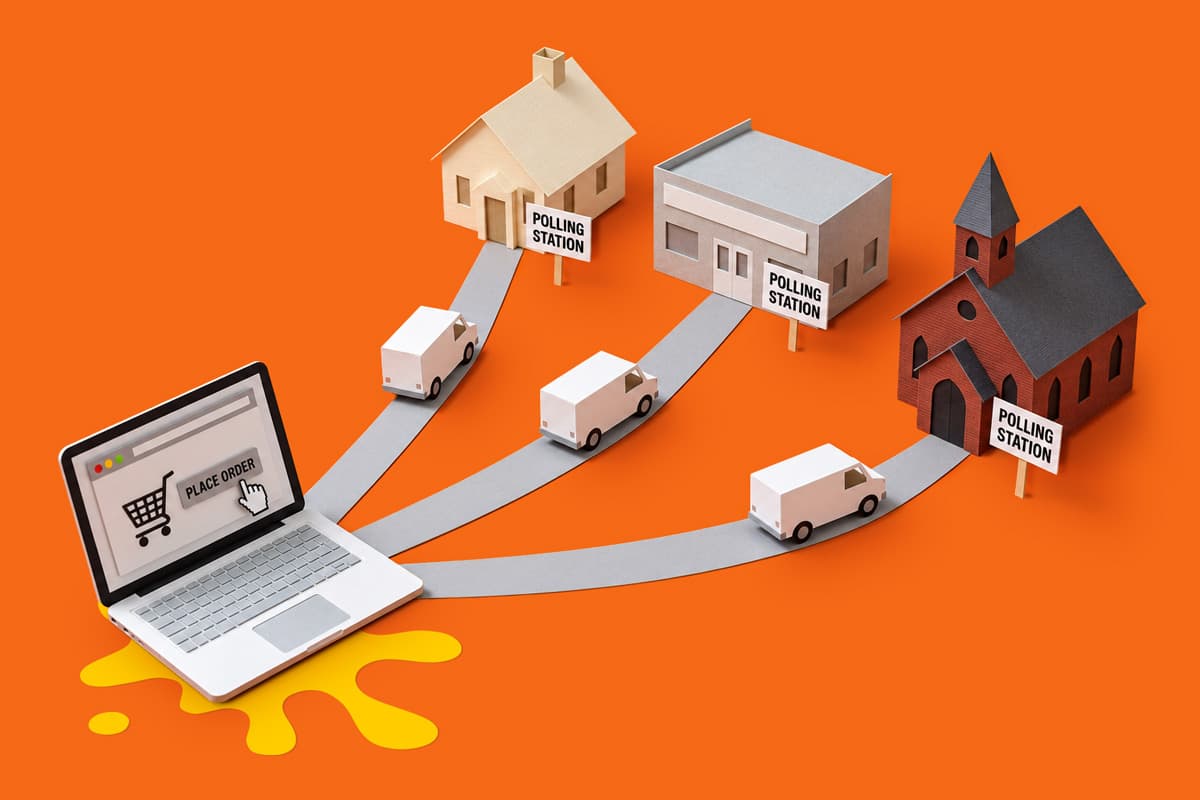
Where the print needs to go can become just as complicated as what’s being printed. A simple campaign may have one delivery address.
Another might need 10,000 leaflets sent centrally, signage split across several local locations and event materials delivered directly to a separate venue. If those destinations aren’t established until the end, the original order structure may no longer make sense.
Building destinations into the campaign map early lets you see whether the most practical route is one central delivery, several separate consignments or direct fulfilment.
For WTTB orders, white label delivery means print can be sent directly to your customer without any branding on the packaging or paperwork. That removes the need to receive the print yourself purely to send it back out again.
Where leaflet distribution is required, that can also be planned separately through our Royal Mail leaflet distribution service.
The key is knowing which route applies to which part of the campaign rather than assuming everything needs to follow the same fulfilment path.
A campaign with multiple versions creates more opportunities for small technical differences between files.
One version might have the correct bleed while another doesn’t. A replacement image could have a lower resolution. A localised design might move text outside the safe area. A new PDF export could introduce RGB elements into otherwise identical artwork.
These are exactly the sorts of differences that can be difficult to spot when several files look almost identical on screen.
Every item ordered through WTTB receives an Essential Artwork Technical Check as standard. Where a job needs another level of scrutiny, the Expert Artwork Technical Check adds manual inspection by our prepress team.
The checks are technical rather than editorial. They don’t proofread copy, verify design choices or confirm the legal accuracy of an election imprint.
Our Support Guides can also be shared before files reach that stage. Many have unbranded versions, which can be useful when a client or their designer needs guidance on bleed, PDF setup, colour or other technical requirements without being directed away from your own business.
Late changes are common in print. Election work can make their impact more noticeable because the dates are less forgiving and the same change may exist across several files.
A changed contact number might affect one leaflet. A changed imprint could affect the leaflet, poster, board and banner. A design adjustment made to the master artwork might need carrying through to six local versions. That means the cost of a change isn’t always the time taken to edit one file. It can be the number of places that change has to propagate through.
This is another reason a clear master and variable structure is useful. When a change arrives, you can identify whether it affects one version, one product family or the campaign as a whole.
It also gives you a clearer point at which to ask whether an approved artwork set should now be considered locked.
The reseller tools we’ve built aren’t there to create a separate workflow for election print. They’re there to take friction out of the workflow you already use.
The useful approach isn’t to use every tool. It’s to identify where a particular campaign is creating extra work and use the resource that solves that problem.
The individual products involved in election printing aren’t necessarily complicated. The complexity comes from how they connect.
One campaign can contain several formats, multiple artwork versions, different quantities, legal imprint requirements, several delivery routes and a deadline that can’t simply be pushed back.
Treating the job as a connected campaign rather than a basket of unrelated products makes those dependencies much easier to see.
Map the versions. Separate fixed artwork from variable content. Lock the important dates. Make compliance approval explicit. Decide where everything is going before production starts. Then the print itself becomes the straightforward part.
Our Election Printing range brings the products together, while the Reseller Hub gives you access to white label fulfilment, Support Guides, artwork technical checks, Saved Quotes, trade pricing and other practical tools when you need them.
You keep control of the client and the project. We’ll handle the production behind it.
Posted on September 10, 2026 by Emma Thompson
Related topics: