Prices
Planning a successful event takes more than booking a venue, setting a date and inviting people along. Every detail needs to work together, from the way people find you to the information they take away afterwards.
That’s where event printing has an important role to play.
Good event print helps people understand where to go, what to do, who they’re speaking to and why your brand matters. It can make a stand easier to spot, a venue easier to navigate and a campaign easier to remember once the event is over.
The UK events market is a busy space. VisitBritain reported that business visits accounted for 6.8 million inbound visits in 2024, contributing £5.9 billion in spend. The Events Industry Alliance also reported that 1,145 exhibitions were held in 2024, attracting 7.2 million visitors.
With that many people attending business events, exhibitions and live experiences, your print needs to do a proper job. It should attract attention, support the visitor journey and make your event feel organised from the moment people arrive.
Here’s how to plan event printing, signage and display materials that help your event run smoothly.
Before you choose banners, signs or printed handouts, get clear on what the event needs to achieve.
Are you trying to generate leads, launch a product, sell tickets, raise money, build brand awareness, support an exhibition stand or welcome guests to a conference?
The purpose of the event should shape every print decision. A product launch might need display boards, premium flyers and branded backdrops. A trade show stand might need roller banners, business cards, leaflets and clear product messaging. An outdoor event might need flags, PVC banners, mesh banners or arch banners that are easier to see from a distance.
Once you know the purpose, it’s easier to decide what print is essential, what’s useful and what isn’t needed.
Event printing works best when it supports the full journey, not just the main event space.
Before people arrive, they may see flyers, leaflets, posters, direct mail, social assets or QR codes that help them register or find out more.
When they arrive, they need clear entrance signage, welcome signs, directional boards and banners that confirm they’re in the right place.
During the event, they may need schedules, menus, product information, sponsor boards, table signs, stand graphics, wall displays and printed takeaways.
After the event, they may keep a business card, flyer, booklet, voucher, postcard or branded item that helps them remember you and take the next step.
That’s why event print should be planned as a complete system. Each piece should have a job to do.
A good event print plan should cover the full visitor journey, from the first sign people see to the printed item they take away. Use this checklist to decide what’s essential for your event and what can support the experience without adding unnecessary cost.
Event stage | What to think about | Useful print options |
|---|---|---|
Before the event | How people find out about the event, register, remember the date or understand the offer. | Flyers, leaflets, posters, postcards, direct mail, QR code print and social campaign print. |
Arrival | How people know they’re in the right place and where they need to go first. | Welcome signs, entrance banners, flags, display boards and directional signage. |
Inside the venue | How people move around, find key areas, read schedules and understand what’s happening. | Venue maps, agenda boards, room signs, table signs, sponsor boards and wall displays. |
Brand presence | How your brand stands out in a busy space and stays consistent across the event. | Roller banners, pop up displays, exhibition stands, branded backdrops and display boards. |
Conversations | What people need during a discussion, demo, product pitch or sales conversation. | Business cards, flyers, brochures, product cards, price lists and presentation folders. |
After the event | What people take away so they can remember you, contact you or take the next step. | Postcards, vouchers, QR code cards, leaflets, booklets, stickers and follow up print. |
You won’t need every item for every event. The aim is to choose print that helps people find their way, understand your message and remember your brand once they’ve left.
Different events need different print. The right choice depends on the venue, audience, weather, budget, message and how long the materials need to last.
Event type | Main print need | Useful print options |
|---|---|---|
Trade show or exhibition | Visibility from a distance, clear stand messaging and printed materials that support sales conversations. | Exhibition stands, roller banners, pop up displays, display boards, flyers, leaflets and business cards. |
Outdoor event | Strong visibility, weather suitable materials and displays that help people find key areas quickly. | Flags, PVC banners, mesh banners, arch banners and outdoor signage. |
Conference | Clear movement through the venue, professional presentation and easy access to schedules or sponsor information. | Welcome signs, directional signage, programmes, agenda boards, sponsor boards and display boards. |
Charity event | Clear messaging around the cause, donation points, sponsor recognition and ways for people to get involved. | Posters, banners, QR code signs, flyers, sponsor boards and information displays. |
Retail pop up | Brand impact in a smaller space, clear pricing and printed materials that encourage people to buy or follow up. | Table signs, display boards, posters, flyers, stickers, postcards, price lists and promotional cards. |
Product launch | A polished setting that explains the product, supports demos and gives people something useful to take away. | Display boards, branded backdrops, flyers, postcards, product cards, presentation folders and premium printed materials. |
This helps you move beyond naming products and think about where each type of print fits. The more specific the event, the more focused your print plan can be.
Good signage helps people move through an event without having to ask for directions. It removes friction, makes the venue feel easier to navigate and helps people get to the right place at the right time.
Start by thinking about where people arrive, where they need to go first, where queues may form and where people are most likely to get confused. Then look at the viewing distance. A sign that works at a reception desk may not be large enough for a hall, entrance, car park or outdoor space.
For larger spaces, you may need bigger signage, stronger contrast and repeated directions at key points. For smaller venues, clear reception signs, table signs and display boards may be enough.
The aim is simple. If people can find the entrance, toilets, talks, stands, food areas, registration points and exits easily, the event will feel more organised.
Banners and displays are useful when you need height, impact and brand presence.
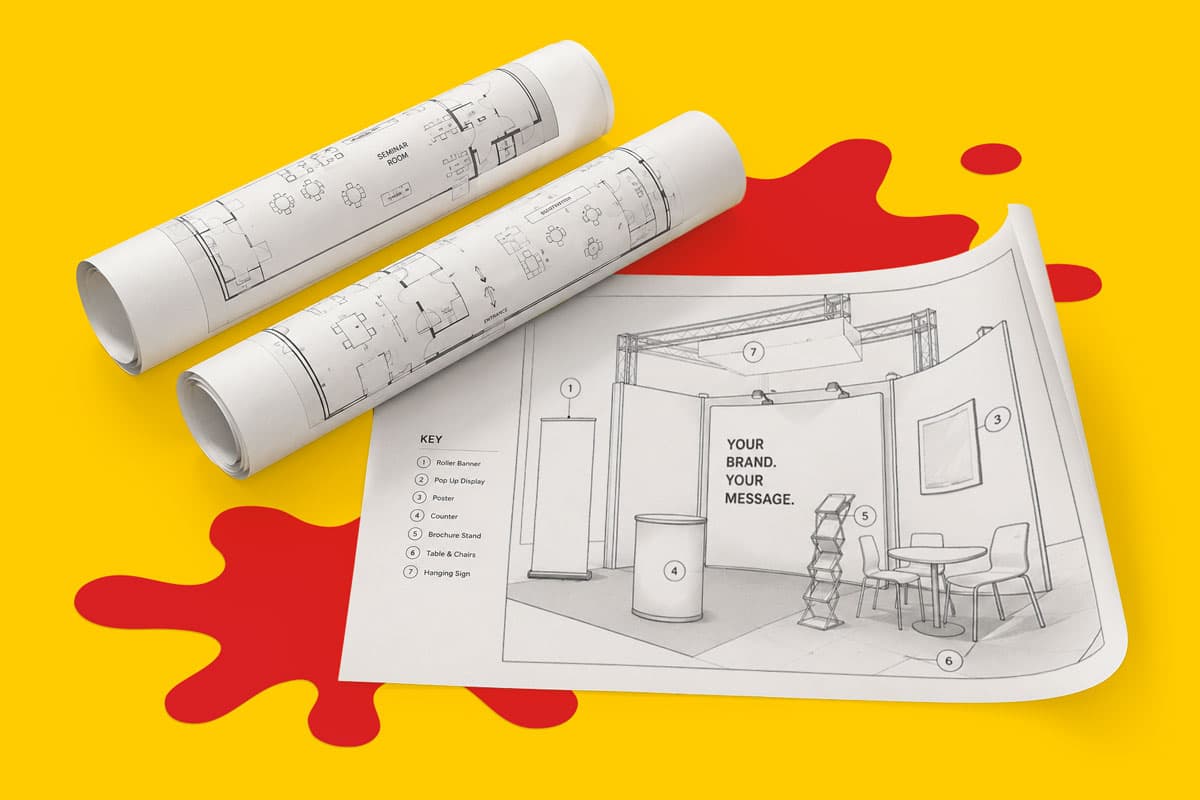
Roller Banners work well indoors, especially for exhibitions, receptions, retail events and compact display areas. They’re portable, easy to position and useful when you need a branded backdrop or key message in a limited space.
Pop Up Displays are useful for larger exhibition stands, product demos, press moments or branded photo areas.
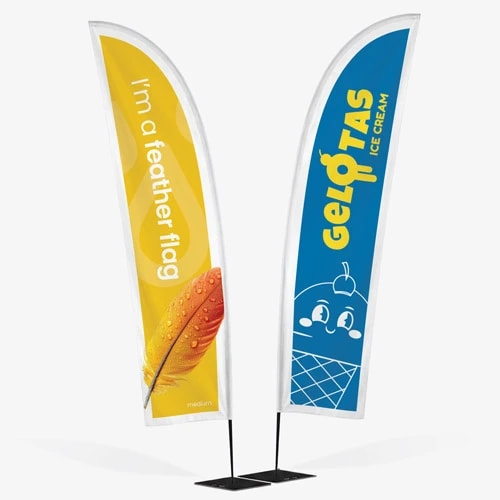
Flags can help attract attention outdoors or in open spaces where movement and height make a difference.
Arch Banners work well for entrances, finish lines, event zones and photo opportunities.
Display Boards are useful for maps, schedules, menus, sponsor lists, directions and product information.
Each format has a different job. The best event print plan often uses several formats together rather than relying on one item to do everything.
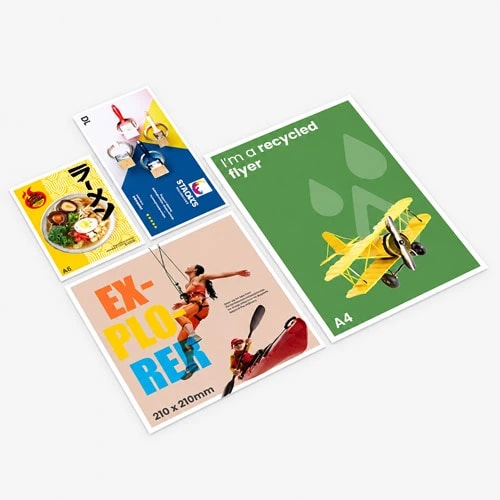
Flyers, leaflets, brochures, cards and postcards can all support an event, but only if they give people a reason to keep them.
A good handout should answer a clear question. What do you offer? What should someone do next? Where can they find more information? Is there an event offer? Is there a QR code to scan? Is there a contact they can speak to?
For exhibitions, flyers and leaflets are useful when people want a quick reminder after a conversation. For product launches, a printed card can summarise benefits and pricing. For charity events, a leaflet can explain the cause and show how to donate. For retail pop ups, a postcard can include a discount code or social handle.
Avoid trying to put everything on one item. Clear print is usually more effective than crowded print.
Event print is often viewed quickly, from a distance or while people are moving. That means design needs to be simple and practical.
Keep the main message short, use large readable headings and make sure there’s strong contrast between text and background. Place important information high enough to be seen, leave enough space around QR codes and avoid putting key details too close to the edge.
Consistency matters too. Colours, fonts, logos, messages and calls to action should feel connected across every printed item, from your entrance signage to your handouts.
If people can’t read the message quickly, the print isn’t doing its job.
For artwork support, use Support Guides, Artwork Technical Checks and Canva Templates to help prepare files correctly before print.
Event print is easier to manage when it’s planned in stages. Large format print, outdoor signage and exhibition graphics usually need more time because artwork, sizing, materials and delivery all need to be checked carefully.
Timing | What to plan | Why it matters |
|---|---|---|
Four to six weeks before | Main signage, exhibition graphics, outdoor banners, flags, display boards and large format print. | These items often shape the overall look of the event, so they need enough time for artwork checks, production and delivery. |
Two to three weeks before | Flyers, leaflets, business cards, programmes, handouts, postcards and printed promotional materials. | These are usually linked to final messaging, offers, schedules and speaker or product details. |
One week before | Final checks on maps, schedules, QR codes, room names, sponsor names and any smaller signs. | This helps catch details that may have changed since the first version of the event plan. |
Final few days | Only essential updates, spare signs or urgent print that couldn’t be confirmed earlier. | Last minute print can help, but core signage shouldn’t be left until the end where possible. |
A clear timeline gives you more control over artwork, quantities, delivery and last minute changes.
Event print isn’t only about how something looks. It also needs to work in the real space.
Before ordering, check the venue rules, wall fixing rules, outdoor display restrictions, table sizes, stand dimensions, ceiling heights, access times, delivery requirements, storage space, lighting levels, expected footfall, weather conditions and how long the print needs to last.
These details can affect the products you choose. A display that works in a conference room may not work outside. A sign that looks clear on screen may be too small in a large venue. A QR code that scans well on a flyer may need to be much larger on a board.
Planning these details early helps avoid problems on the day.
QR codes can make event print more useful, especially when you want people to register, donate, book, download, follow, enter a competition or view more product information.
They work best when they’re used with a clear reason. Instead of placing a QR code on its own, add a simple prompt such as scan to book a demo, scan to donate, scan to download the brochure, scan to view the full range or scan to claim the event offer.
Always test QR codes before print. Check they open the right page, load quickly and work on different devices.
Event print feels more professional when everything looks connected.
For a trade show, that might mean an exhibition stand, roller banner, printed flyers, business cards and a QR code card that all use the same message.
For an outdoor event, it might mean flags at the entrance, banners around the event space, directional signage and printed handouts that all use the same campaign identity.
For a conference, it might mean welcome signage, agenda boards, sponsor boards, programmes and room signs that all feel part of the same event.
A joined up print set makes the event easier to recognise and helps people connect each item back to your brand.
The value of event print doesn’t end when the event closes.
A business card can help a contact remember who they spoke to. A flyer can remind someone about a product. A QR code card can send people to a landing page. A voucher can encourage a later order. A printed booklet can help someone compare options after they’ve left.
Think about what you want people to do after the event, then make sure your printed materials support that next step.
Event planning is easier when your print has a clear purpose. The right signage helps people find their way. The right display materials help your brand stand out. The right printed handouts help people remember what you offer after the event is over.
Whether you’re planning a trade show, conference, charity event, outdoor event, retail pop up or product launch, event printing should help the whole experience feel clearer, smoother and more professional.
Explore WTTB’s Events and Exhibitions Hub to compare event printing, signage, banners, displays and printed materials for your next event.
I’d update the publish date if this replaces the current article, as it’s a substantial refresh with added structure, source backed context and more practical event print guidance.
Posted on May 1, 2026 by Miller Lane-Williams
Related topics:
£38.46
£17.48

£82.26
£71.10