Prices
Not all stickers are made equal, and choosing the right one involves more than picking a size and uploading a design. From product labels and packaging seals to shop window promotions and floor graphics, different sticker materials, adhesives and finishes are designed for different jobs.
Should you choose white or clear vinyl? What's the difference between removable and permanent adhesive? And when would you need reverse printing rather than forward printing?
Whether creating stickers for your own business, selling print to customers or preparing artwork for a client, understanding the options can help you get the right result.
Here is our guide to choosing sticker materials, finishes and formats that work for your project.
Before choosing a material, think about where the sticker will go and what you need it to do.
A label attached to a product box has different requirements from a promotional graphic displayed inside a shop window. Similarly, a sticker placed on the floor needs to cope with foot traffic, while one used as a thank you seal on a parcel has a much simpler job.
Start by asking yourself a few questions:
These details will help narrow down the options before you start thinking about finishes and artwork.
The material you choose affects how your design looks, how it attaches to a surface and where it can be used. Here is how the main options compare.
White self adhesive material provides an opaque background, meaning the surface underneath won't show through your design.
It is a useful option when you want solid colours, clear text and consistent branding, particularly on surfaces where the background might otherwise interfere with your artwork.
Think branded packaging, product labels, promotional stickers and window graphics.
For example, a bakery might use white stickers to label boxes and bags, while a retailer could use white vinyl window stickers to create a bold promotional message.
For window applications, WTTB offers white vinyl in permanent and removable options, giving you flexibility depending on how long the display needs to remain in place.
Choose white self adhesive when you want an opaque background, strong colour visibility or a design that doesn't rely on the surface underneath.
Clear Cling is a transparent material that uses static cling rather than a traditional adhesive to attach to suitable glass surfaces.
It is particularly useful for temporary window graphics, such as seasonal promotions, short campaigns or displays that need to be removed when the promotion ends.
Because the material is transparent, areas without printed artwork allow the glass behind to remain visible.
A café might use Clear Cling for a Christmas window promotion, while a shop could use it for a limited time sale or an upcoming event.
Unlike traditional self adhesive vinyl, Clear Cling doesn't rely on a sticky adhesive backing. However, that doesn't mean every graphic can be repeatedly removed and reapplied indefinitely.
Choose Clear Cling when you need a temporary, transparent window display without a conventional adhesive.
Clear adhesive vinyl also offers a transparent finish, but it uses an adhesive to attach to the surface.
Our clear window vinyl is available as a semi permanent option, making it useful for displays intended to remain in place longer than a short campaign.
This could include business branding, window graphics, decorative details or information displayed on glass.
The transparent finish can help graphics feel more integrated with the window rather than appearing as a solid panel.
Choose clear adhesive when you want a transparent window graphic with adhesive attachment for a longer lasting application.
Not every sticker material is suitable for being walked on.
Anti slip floor vinyl is designed specifically for applications where graphics need to withstand foot traffic while providing a slip resistant surface.
Our Floor Stickers use specialist textured vinyl with an R10 slip rating, making them suitable for appropriate pedestrian applications.
They can be used for directional messages, retail promotions, event wayfinding, branded displays and customer guidance.
For example, a retailer could use floor graphics to highlight a promotional area, while an exhibition organiser might use them to help visitors navigate a venue.
Before applying floor graphics, always check that the surface is suitable, clean and dry, and follow the relevant application guidance.
Choose anti slip vinyl when your design needs to be applied to a suitable floor surface where people will walk over it.
Choosing the right adhesive is just as important as choosing the material.
A sticker intended for a seasonal window campaign has very different requirements from one designed to remain in place for an extended period.
Adhesive type | Best suited to | What to know |
|---|---|---|
Permanent | Longer lasting branding and displays | Designed for stronger adhesion where regular removal isn't required |
Removable | Temporary campaigns and changing displays | Intended to be removed more easily, although results depend on the surface |
Semi Permanent | Clear window graphics intended to remain in place | Offers adhesive attachment for displays where a longer lasting hold is needed |
Cling | Temporary transparent glass displays | Attaches without a conventional adhesive |
It is worth remembering that removable doesn't automatically mean reusable or guaranteed residue free.
How a sticker behaves during removal depends on the material, the surface, the conditions and how long it's been applied.
For the best results, always match the adhesive to the intended surface and duration of use.
This is one of the most important decisions when ordering window stickers, particularly if your design needs to be viewed through glass.
The difference comes down to which side of the glass the sticker will be applied to and where people need to read the artwork.
Forward printing is the standard approach, where the artwork is printed to be viewed directly from the printed face.
For example, a promotional sticker applied to the outside of a shop window can be forward printed so customers walking past see the design as intended.
This is also the appropriate approach for opaque white vinyl window graphics.
Choose forward printing when the printed face of the sticker will be directly visible to the intended audience.
Reverse printing is commonly used for clear window stickers applied to the inside of glass but intended to be viewed from outside.
The artwork is printed in reverse so that it appears the correct way around when viewed through the window.
For example, a shop might want to advertise an offer to people walking past, but prefer to position the sticker inside the glass. Reverse printing allows the message to face outward while the graphic is applied internally.
With WTTB's reverse printed window stickers, the artwork is automatically flipped during production, so you don't need to reverse the design yourself.
Choose reverse printing when you want a suitable clear sticker applied inside glass and viewed correctly from the opposite side.
Clear material introduces another design decision because transparent areas allow the background to influence how printed colours appear.
White ink can help increase the opacity and visibility of selected design elements.
For example, a shop window graphic containing coloured lettering may benefit from a white ink backing to help the colours stand out against whatever is behind the glass.
WTTB offers options for selective white ink on clear window stickers, allowing you to support particular elements while retaining transparency elsewhere.
The right choice depends on the design, background and viewing conditions. Always check the white ink artwork requirements before preparing your file.
Once you've chosen the material, it's time to think about how the sticker will be finished.
Square cut stickers are trimmed to a rectangular or square shape with straight edges.
They're useful for product information, rectangular logos, opening hours, promotional messages and graphics that don't require a custom outline.
For example, a shop window sticker displaying opening times may work perfectly well as a rectangle, while a product information label might benefit from a simple square format.
Choose square cut when a standard square or rectangular outline suits the design and application.
Cut to shape stickers are produced using a custom cutting path, allowing the finished sticker to follow a particular shape rather than a standard square or rectangle.
This can work well for logos, illustrated graphics, shaped window displays and promotional decals.
For example, a café might use a window graphic cut around its logo, while a retailer could create an illustrated seasonal display with a more distinctive outline.
Because the sticker follows a custom shape, the artwork needs a correctly prepared cut path.
WTTB requires a designated spot colour cut path set up according to the relevant artwork specifications. Our Cut to Shape Support Guide explains how to prepare this correctly.
Choose cut to shape when the outline is an important part of the design or you want to avoid unnecessary background material surrounding the graphic.
Material and shape aren't the only decisions. How stickers are supplied can make a practical difference, especially for businesses applying them regularly.
Individual stickers are supplied separately, making them convenient when each sticker needs to be handed out, sold or included with an order.
They're useful for promotional giveaways, event handouts, parcel inserts and individual branding applications.
For example, a graphic designer creating promotional merchandise for a customer might choose individual stickers because they're easy to distribute.
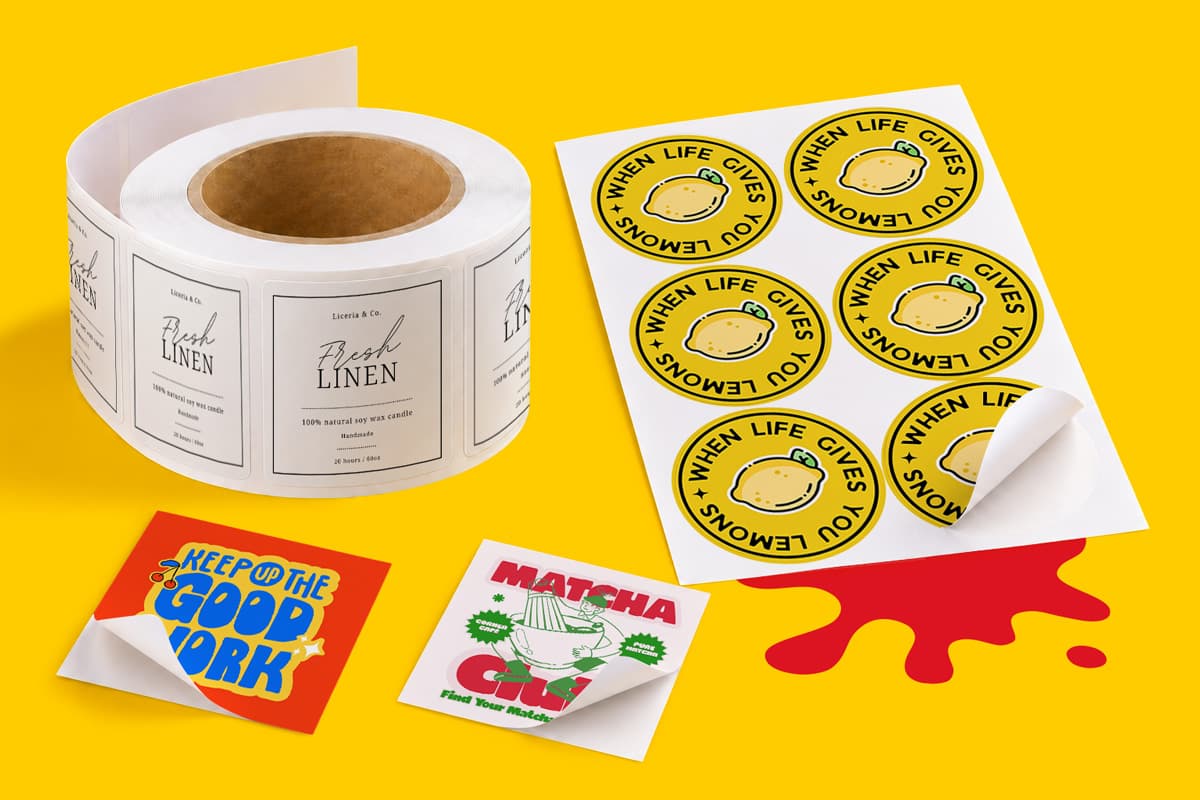
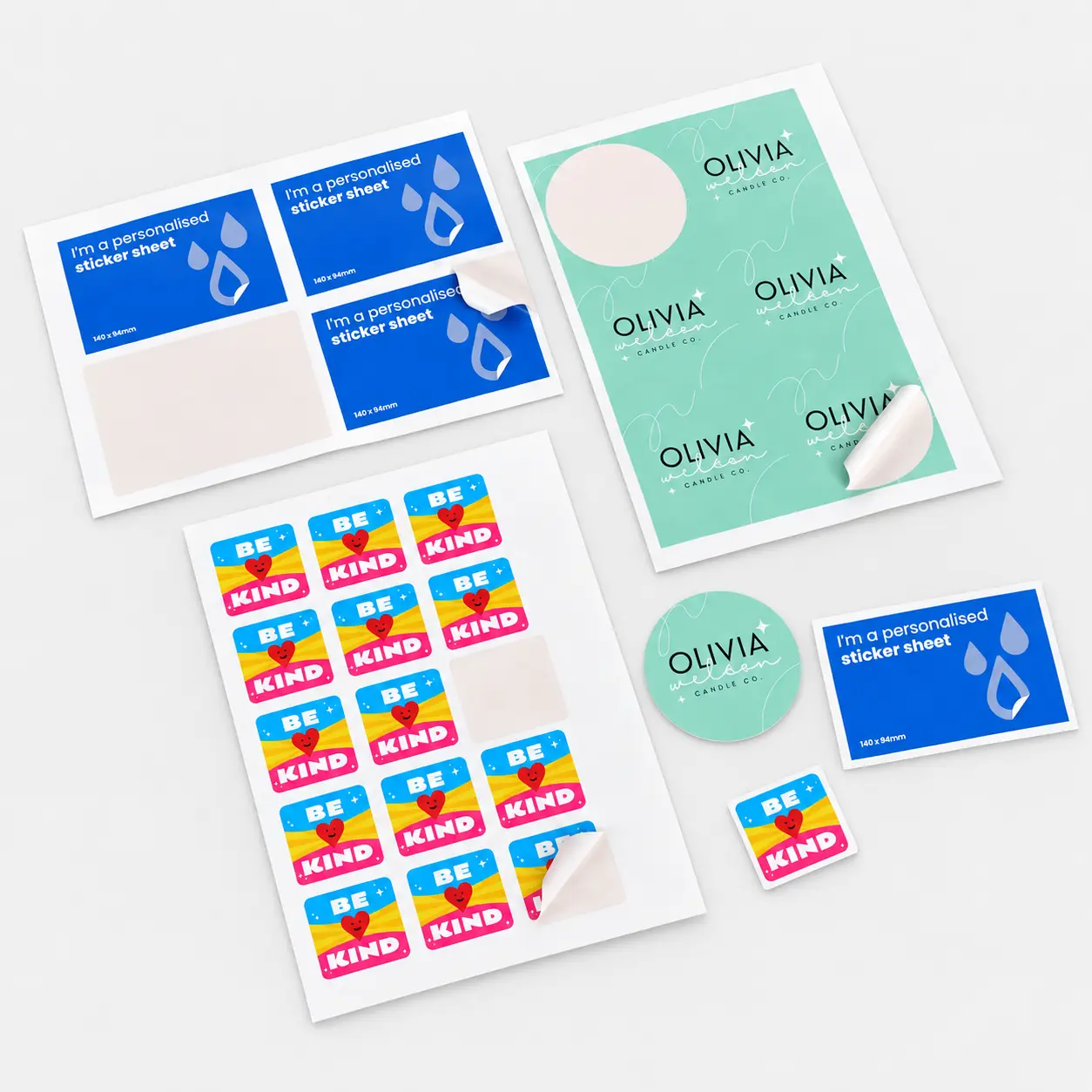
Sticker sheets contain multiple peelable stickers arranged on a backing sheet.
At WTTB, each sheet contains repeated copies of the same design, available in selected round, square and rectangular formats.
This makes them useful for product labels, packaging details, loyalty stickers and repeated branding tasks.
A small business labelling different product batches could use separate sheets for each design, keeping the labels organised and easy to access.
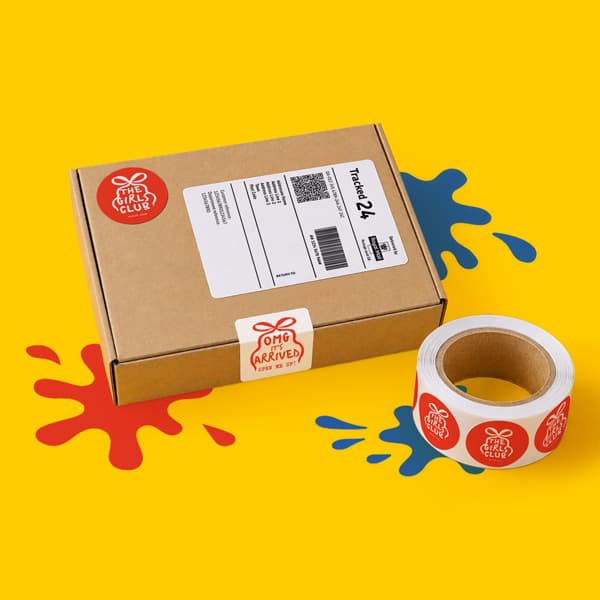
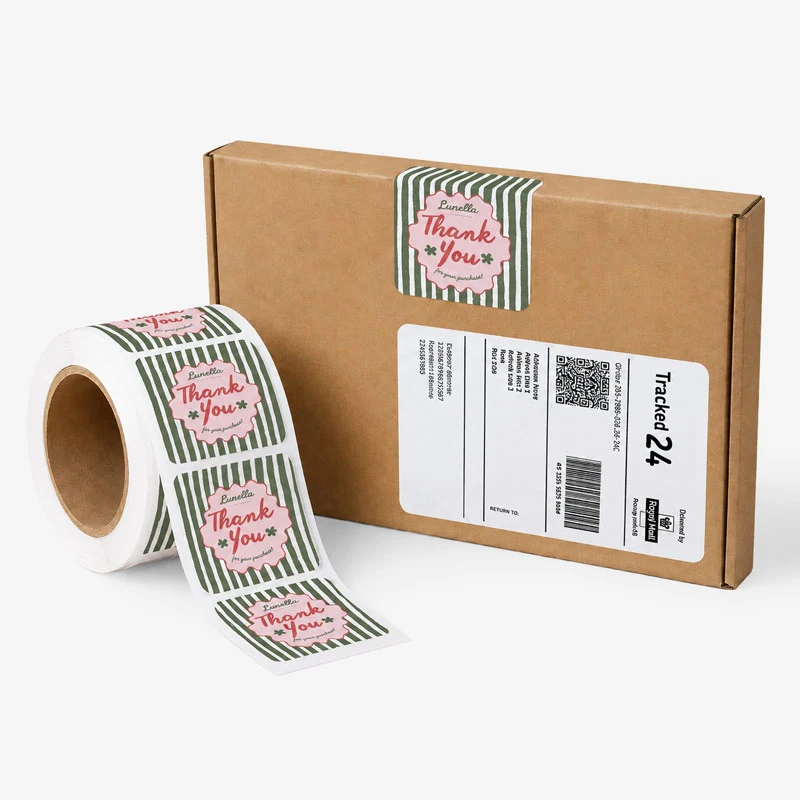
Stickers on a roll are particularly useful when stickers need to be applied regularly, such as during order packing or product labelling.
Rather than handling individual stickers, businesses can work directly from the roll as they prepare packaging, label products or seal parcels.
For example, an Etsy seller preparing regular customer orders could use branded stickers on a roll to make the packing process more convenient.
The deciding factor is how the stickers will be used. Individual stickers suit distribution, sheets offer a convenient format for repeated labels, while rolls can be practical for ongoing packing and labelling.
If you're still deciding, start with the intended use rather than the product name.
What are you creating? | Options worth exploring |
|---|---|
Product and packaging labels | White self adhesive stickers, sticker sheets or stickers on a roll |
Temporary shop window promotion | Removable white vinyl or clear cling |
Longer lasting transparent window graphic | Clear semi permanent adhesive vinyl |
Internal window graphic seen from outside | Clear vinyl with reverse printing |
Bold opaque window lettering or promotion | Forward printed white vinyl |
Floor directions or promotional graphics | Anti slip floor stickers |
Individual promotional giveaways | Precut stickers |
Custom shaped logos and graphics | Cut to shape stickers |
Regular eCommerce packing seals | Stickers on a roll |
These are starting points rather than fixed rules. Material availability, application surface and finishing options vary by product, so always check the relevant specifications before ordering.
A little preparation can prevent problems with application, visibility and the finished result.
Choosing clear stickers without thinking about the background
A design that looks strong against white artwork may become difficult to see when applied to glass. Think about what is behind the sticker and whether white ink could improve visibility.
Choosing the wrong print operation
If a sticker is being applied inside a window but viewed from outside, the correct reverse printing option may be needed. Check the intended viewing direction before ordering.
Using standard vinyl for floor graphics
Floor applications need appropriate slip resistance and durability. Choose a material designed for that use rather than assuming standard adhesive vinyl will be suitable.
Assuming removable means reusable
A removable adhesive may allow easier removal, but it doesn't guarantee the sticker can be repeatedly applied without affecting the material or adhesion.
Forgetting about the cutting path
Custom shaped stickers require additional artwork preparation. Make sure the cutter path meets the specifications for your chosen product.
Not checking the application surface
Different materials work better on different surfaces. Check whether the intended surface is suitable, particularly for window displays and floor graphics.
Ordering the wrong supply format
If someone needs to hand out individual stickers, a roll may not be the most convenient format. Likewise, a business packing regular orders may benefit from a format designed for repeated application.
Once you've chosen the right sticker, the next step is preparing artwork that matches the material, size and finish.
Make sure you've checked the required dimensions, bleed and safe areas, particularly if you are creating custom shapes or specialist window graphics.
Transparent materials and white ink may require additional artwork preparation, while cut-to-shape designs need correctly defined cutting paths.
If you're designing in Canva, our premade templates can help with sizing and artwork setup for supported products. You can add your own artwork or use Canva's design tools to create something from scratch.
Our Sticker Stocks and Finishes Support Guide provides a technical reference for materials, print orientation and cutting options, while our other Support Guides can help with preparing print ready artwork.
From packaging labels and promotional giveaways to shop window graphics and floor displays, stickers can do a lot more than simply carry a logo.
The right choice comes down to where the sticker will be applied, how long it needs to last, how the design should appear and how the finished stickers will be used.
Whether you're preparing artwork for a client, branding your own products or planning a new promotion, understanding these differences helps you choose a sticker that works for the job.
Because when the material, finish and application all come together, everything starts to stick.
Posted on October 23, 2026 by Ben Riches
Related topics:
£31.54
£16.41
£32.00
£29.85


£22.53