Prices
Selling print means selling something customers can see, touch and use.
But when you're trying to win a customer, recommend products or explain what is possible, you don't always have the finished piece sitting in front of you.
That is where a good image library can make a difference.
For trade resellers, having access to professional, ready-to-use images of printed products gives you something valuable: a way to show customers what you're talking about.
And with the right images, you don't have to start every sales conversation with a blank page.
An image library is a collection of photographs and visual examples showing printed products in use.
Rather than simply showing an isolated photograph of a flyer, brochure or banner, a good image library shows those products in the environments they're designed for.
Whether it's a menu on a restaurant table, signage in a retail environment, a brochure being used in a business setting or promotional print displayed at an event, the aim is simple: make print easier to visualise.
For a print supplier, this can be particularly useful because customers don't always know what products are available, how they could be used or which option might suit their business.
A relevant image can answer those questions much faster than a paragraph of product specifications.
You likely don't have time to photograph every product you sell. And, even if you did, your own collection would only show the products you've already had the opportunity to order and photograph.
That can make it difficult to demonstrate the breadth of what you can offer.
An image library gives you access to examples beyond the jobs you've personally produced.
Instead of waiting for the perfect customer project to come along before you can show a particular product in action, you already have something to put in front of them.
This is especially useful when you're trying to introduce customers to products they haven't considered before.
A product name tells a customer what something is. An image can help show them why they might want it.
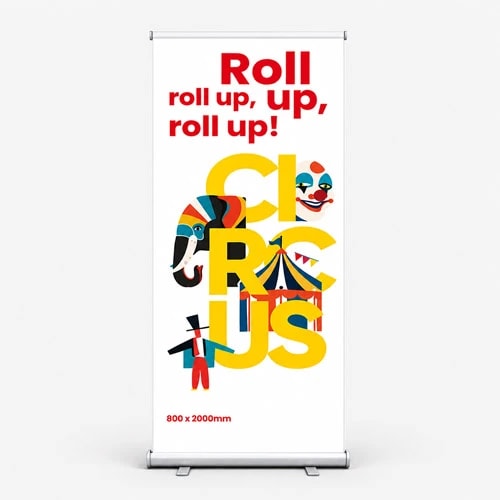
Take a roller banner, for example. You can tell a customer that it is suitable for exhibitions, events, receptions and promotional displays.
Or, you could show them one positioned at an exhibition stand.
The second option immediately gives them more information. They can see the scale, how it sits within a space and how their own branding might look on something similar.
The same applies to almost every type of print:
The image provides the context that the product description can't.
The real value of an image library isn't simply having photographs of products.
It's having examples of applications.
A print reseller might know exactly what a particular product is capable of, but the customer they're speaking to may never have encountered it before.
Showing an example gives both sides something to work from.
It can help answer questions such as:
That makes the image library a useful reference point during a sales conversation, rather than just another folder of marketing assets.
Think about how most of us shop.
When you step into a well-designed store, you rarely just see a single item on a shelf; you see a curated display. A jacket might be styled alongside a matching scarf and bag, or a desk display might pair a laptop with a planner and desk mat.
The products are being shown together in a way that helps you imagine how they might fit into your own life.
Print works in much the same way.
When a customer looks at a visual of a product they already know they need, contextual imagery helps them see the bigger picture. They aren't just looking at a business flyer in isolation; they’re seeing how that flyer sits alongside a matching roller banner, or how a brochure fits into a complete event display.
Seeing products placed together in a natural, realistic context can spark ideas. It helps customers envision a complete, cohesive campaign without you having to explain every possibility from scratch. Instead of simply seeing individual products, they can start to see how those products could work together.
Of course, that visual inspiration only works if the environment feels authentic to the person looking at it.
A hotel is unlikely to be inspired by the same setup as a construction company. A retailer has different requirements from a professional services firm.
That's why industry-specific imagery can be particularly valuable.
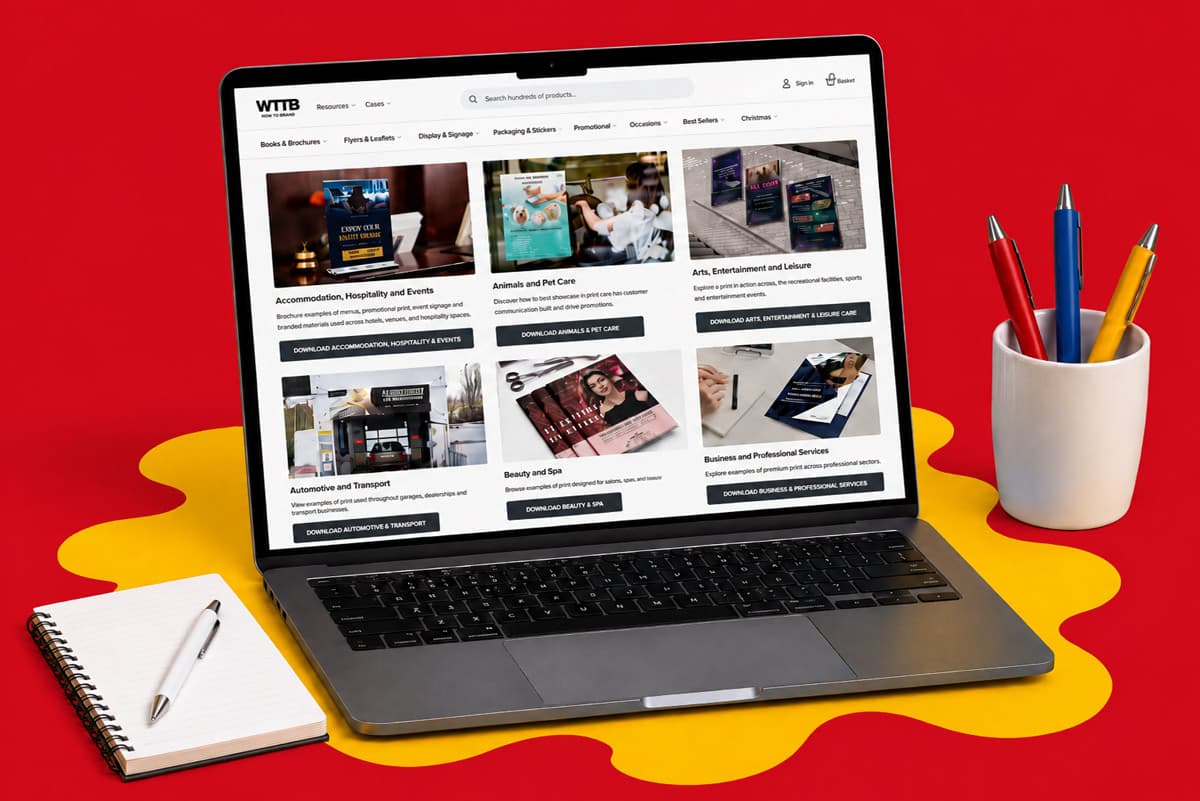
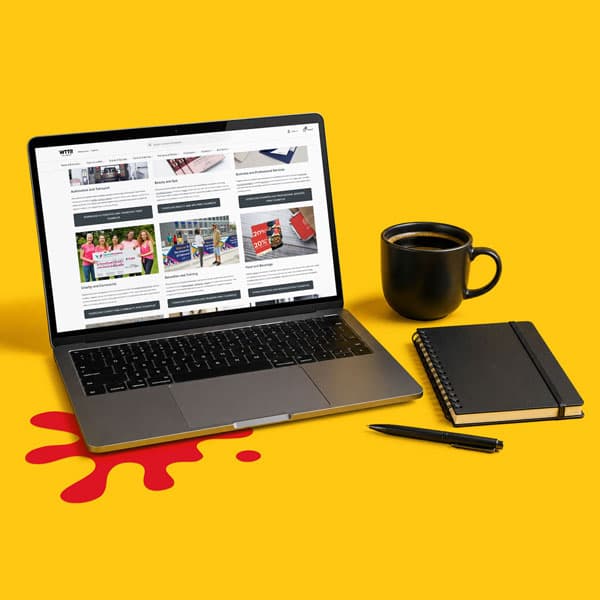
Our image library includes downloadable image packs covering industries such as hospitality, retail, healthcare, construction, property, education, beauty, charity and professional services.
That means a reseller can find examples that are already relevant to the customer they're talking to. Instead of showing someone a random collection of print products, you can show them examples that make sense for their industry.
And relevance matters. A customer is far more likely to think “We could use something like that” when the example looks like something that belongs in their world and when they see how multiple products work together in that setting.
There is another benefit to having a broad library of imagery: it can remind you what's possible.
It's easy to fall into a routine with print. You might have regular customers ordering business cards, flyers and brochures, so those become the products you naturally think about first.
But print is a much bigger category than the products you sell most frequently.
Browsing industry-specific imagery can expose you to applications you hadn't considered for a particular customer:
The image doesn't have to result in an immediate sale. Sometimes it simply gives you another idea to keep in mind for the next customer conversation.
A useful image bank shouldn't just sit untouched until you need a photograph. The more valuable approach is to build it into your normal workflow.
You might use relevant imagery when:
The important thing is that you don't need to create all of this imagery yourself.
You don't need to organise your own photoshoot, wait for the perfect customer project or build a collection of examples from scratch.
The image library gives trade resellers access to professionally created, downloadable imagery showing print in real-world settings.
With industry-specific packs covering sectors from hospitality and retail to construction, healthcare, property and professional services, you can find examples that are relevant to the customers you're trying to reach.
And, because the images are white-label and free for customer use, you can bring it into your own marketing, presentations, proposals and customer conversations without having to create an entire image bank from scratch.
In other words, we've done the photography so you can concentrate on selling the print.
One of the easiest mistakes is treating an image library as somewhere you go only when you need a picture for a website.
Its value can be much broader than that.
Spend some time exploring the industries you already work with. Look at the products featured. Pay attention to applications you don't normally talk about. Save examples that could be useful for future customer conversations.
You may find that an image you discover today becomes the starting point for a much larger conversation tomorrow.
The more products you sell, the more difficult it becomes to physically demonstrate everything you offer. You can't carry every format, finish and application into every customer meeting.
But you can carry examples.
A good print image library gives you a way to do exactly that. It gives customers something to look at, gives you something to talk about, and subtly encourages them to envision the bigger picture.
That's why the WTTB Image Library is more than a collection of attractive print photography.
It's a visual toolkit built to help print suppliers and trade resellers show their customers what is possible.
So, next time you're talking to a customer about their next project, don't just tell them what you can print. Give them something to look at. Ready to show your customers what's possible?
Explore the WTTB Image Library and start building your visual toolkit today.
Posted on September 4, 2026 by Emma Thompson
Related topics: