Prices
When it comes to printing, size really does matter. But bigger doesn't always mean better. Whether designing flyers, printing posters, putting together brochures or creating promotional materials, choosing the right paper size can make a big difference to how your message is seen, read and remembered.
From familiar A4 sheets to compact A6 flyers and large A1 posters, every format has its strengths. The trick is finding the right fit for your content, audience and how the finished product will be used.
In this guide, we're breaking down the most common UK paper sizes, explaining where they work best and sharing practical tips to help you choose the right dimensions for your next print project.
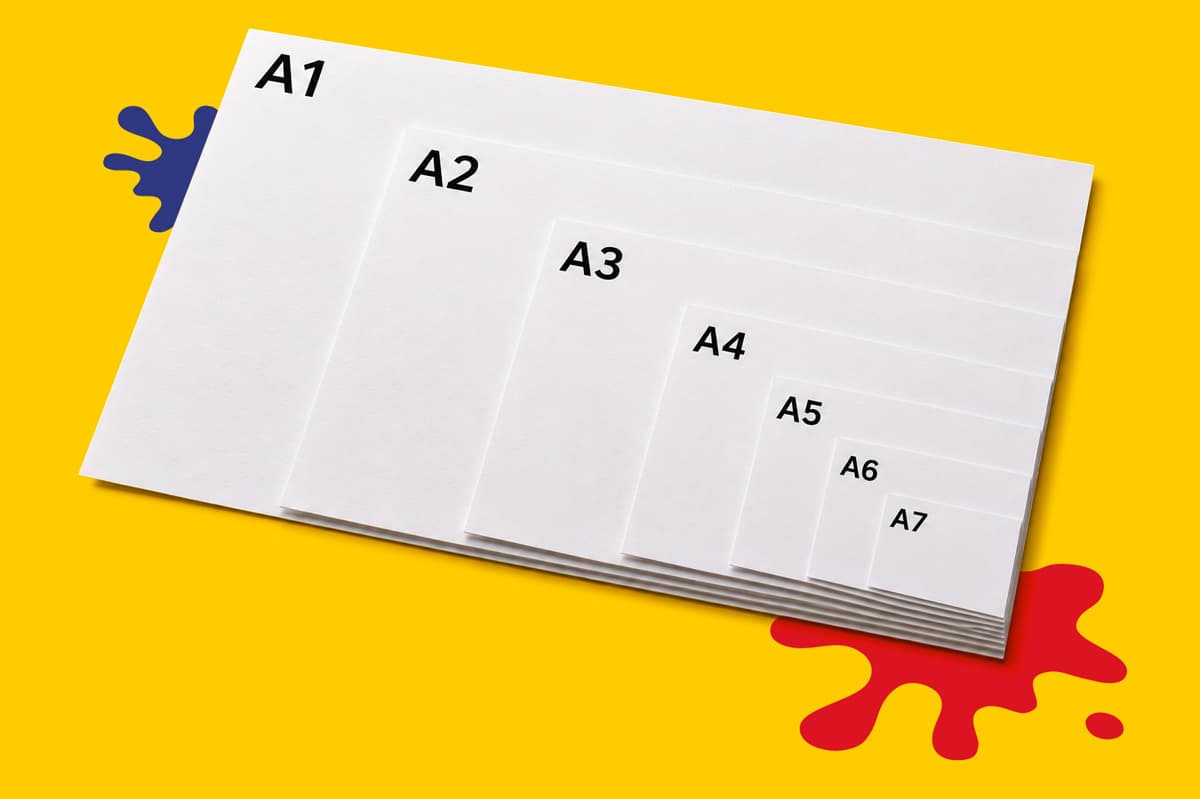
The A series is the most widely recognised paper sizing system in the UK. It includes familiar formats such as A4, A5 and A3, along with larger sizes commonly used for posters and display print.
The clever part is how the sizes relate to one another. Each time you move down one size, the sheet has approximately half the area of the previous one. Fold an A4 sheet in half and you get A5. Fold A5 in half and you get A6.
Paper size | Dimensions (mm) | Common uses |
|---|---|---|
A0 | 841 x 1189mm | Large posters, plans, technical drawings |
A1 | 594 x 841mm | Event posters, shop displays, exhibitions |
A2 | 420 x 594mm | Promotional posters, retail displays |
A3 | 297 x 420mm | Posters, larger flyers, presentation materials |
A4 | 210 x 297mm | Brochures, leaflets, documents, catalogues |
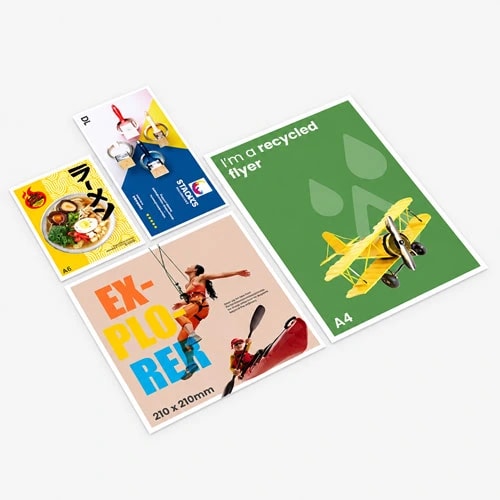
A5 | 148 x 210mm | Flyers, booklets, menus, programmes |
A6 | 105 x 148mm | Flyers, postcards, invitations |
A7 | 74 x 105mm | Small promotional cards, compact inserts |
These measurements refer to the finished paper size, before any additional bleed is applied.
Smaller formats are particularly useful when you need to get a message into someone's hands without giving them too much to read.
A6: Keep it short and sweet
At 105 × 148 mm, A6 is a compact format that works well for simple, focused messages.
Think promotional flyers, postcards, invitations, discount vouchers or inserts tucked into customer orders. It's small enough to distribute conveniently, but still has room for a clear headline, supporting details and a QR code.
For example, an independent café promoting a weekend offer might only need a short message, a date and a call to action. An A6 flyer could comfortably do the job without leaving large areas of unused space.
Choose A6 when you have one main message, want something compact or need printed materials that are easy to hand out and include in parcels.
A5: A little more room to work with
A5 measures 148 × 210 mm, giving you twice the area of A6.
That extra space can make a difference when you're working with multiple offers, product imagery, event details or information that needs a little more explanation.
For instance, a restaurant advertising a special menu might find A5 more suitable than A6 because it gives each dish and price room to breathe. Similarly, an event flyer with a programme, venue details and booking information may benefit from the larger format.
A5 is also useful for small booklets, programmes and brochures where portability matters.
Choose A5 when your design needs more breathing room, you are combining text and imagery, or you want a compact format without squeezing the content.
So which is better?
Neither is automatically the better choice.
If the message can be understood in a few seconds, A6 may be enough. If readers need to spend longer with the information, A5 gives you more flexibility.
A useful test is to print your design at its intended size before ordering. If the text feels cramped or the images lose impact, moving up a size may help more than simply shrinking everything to fit.
A4 and A3 are among the most versatile formats because they work across everyday business printing and promotional materials.
A4: The familiar all rounder
A4 measures 210 × 297 mm and is the standard size for many office documents.
It's also useful for brochures, information sheets, menus, programmes and product guides.
The main advantage of A4 is familiarity. It's easy to handle, file and distribute, while offering enough room for headings, images, tables and more detailed information.
For example, a property agent might choose A4 for a property information sheet featuring multiple photographs, floor plans and key details. A business might use the same format for a product brochure or training document.
Choose A4 when information is the priority, customers need time to read the content, or the finished piece needs to fit familiar document and filing formats.
A3: Give your message more presence
A3 measures 297 × 420 mm, giving you twice the area of A4.
That makes it particularly useful for posters, promotional displays, presentations and artwork that needs to be viewed rather than held.
A3 can also accommodate more detailed diagrams or larger images, making it useful when smaller text and graphics would otherwise become difficult to follow.
For example, a restaurant could use an A3 poster to promote a special event on a noticeboard, while an A4 flyer might be more suitable for sharing the full details with customers.
Choose A3 when you want more visibility, need room for detailed visuals or are creating print intended for a wall, display or presentation.
That said, paper size becomes particularly interesting when folding is involved.
An A4 sheet folded once creates an A5 finished format with four printable pages. An A3 sheet folded once creates an A4 finished format, also with four pages.
This can be useful for brochures, menus and information leaflets because folding gives you a way to organise more content without handing customers one large open sheet.
Just remember that flat size and finished size are different. When ordering folded products, always check which measurement is being requested and use the appropriate artwork template.
Large format print is all about visibility, but the right size depends on where the finished product will be displayed and how far away people will be when they see it.
A2: A noticeable step up
At 420 × 594 mm, A2 works well for promotional posters, shop displays, event announcements and indoor advertising.
It's a practical option when A3 feels too small but a much larger poster would overwhelm the available space.
An A2 poster could work well for a shop window promotion, an indoor noticeboard or a display where customers will view the message from a relatively short distance.
A1: More room to make an impression
A1 measures 594 × 841 mm and gives designs considerably more presence.
It's useful for event posters, retail displays, exhibition graphics and promotional messages that need to attract attention across a larger space.
For example, a community event poster displayed in a busy entrance might benefit from A1 rather than A3, particularly if the headline needs to be visible before people approach it.
A0: Think big
A0 is the largest standard A series format, measuring 841 × 1189 mm.
It's commonly used for large posters, technical drawings, architectural plans and detailed visual information.
An A0 poster can create a strong visual presence, but it also needs enough display space and a design that makes effective use of the larger area.
Bigger print doesn't automatically mean more effective print. A large poster packed with small text can still be difficult to read, especially from a distance.
How do you choose between them?
Start by thinking about where the print will go.
An A2 poster might be suitable for a noticeboard where people can stand close enough to read supporting information. An A1 poster could work better in a busy entrance where the main message needs greater visibility. A0 may be appropriate for large display areas or detailed plans that benefit from the additional space.
Also think about viewing distance. As people move further away, headlines and important information generally need to become larger and simpler.
The aim isn't to fill the available space with more information. It's to make the most important message easy to notice and understand.
Not every print project needs to follow the A series. Sometimes a different shape or proportion makes more sense for the content.
DL: Slim, practical and familiar
DL measures 99 × 210 mm and is a common choice for compliment slips, promotional inserts and folded leaflets.
Its slim shape works particularly well for compact information, vouchers, takeaway menus and promotional materials that need to sit neatly inside envelopes or alongside other documents.
A DL leaflet can also make good use of folding, allowing information to be organised into separate panels.
Choose DL when you need a slim format for inserts, promotional information or a compact leaflet that is easy to store and distribute.
Square formats: A different way to present your print
Square formats, such as 148 × 148 mm and 210 × 210 mm, offer a different visual balance from traditional rectangular paper sizes.
They can work particularly well for invitations, photographic brochures, creative portfolios, menus and visually led publications.
A square brochure might suit a photographer showcasing imagery, while a square invitation can give an occasion a distinctive feel.
However, square formats aren't automatically more effective. They should suit the design and content rather than simply being chosen because they look different.
Choose square when the proportions complement your imagery, brand style or the way you want the finished product to be handled.
Custom sizes: When standard doesn't quite fit
Custom paper sizes give you more flexibility when a project calls for unusual proportions or specific dimensions.
They can be useful for bespoke inserts, packaging components, promotional materials or designs that need to fit an existing holder, display or envelope.
For example, a product insert may need to fit neatly inside a particular box, while a promotional card might require an unusual shape to complement the design.
Before choosing a custom size, check whether a standard format could achieve the same result. Standard dimensions can make design, ordering and compatible accessories more straightforward.
If custom dimensions are essential, confirm the available size limits for your chosen printed product before preparing artwork.
With so many formats available, choosing the right size can feel like a balancing act. The easiest approach is to start with what the print needs to achieve, rather than picking a format first. Here is a practical starting point:
Your print project | Sizes worth exploring | Why? |
|---|---|---|
Promotional handouts | A6 or A5 | Compact and easy to distribute |
Thank you cards or parcel inserts | A6 or DL | Convenient for packaging and short messages |
Menus or information leaflets | A5, A4 or DL | Choose based on content and folding |
Brochures or product guides | A5, A4 or Square | Room for imagery and detailed information |
Noticeboard or smaller posters | A3 or A2 | Suitable for closer viewing |
Large event or retail posters | A1 or A0 | More space for messages viewed from a distance |
Custom packaging inserts | DL or custom sizing | Fit the available space |
These are suggested starting points rather than fixed rules. Always consider the specific product, how much information you need to communicate and the available printing options.
For print resellers and designers, these are also useful questions to ask when helping customers choose the right format for their projects.
Even experienced designers can run into sizing problems, particularly when switching between products or adapting existing artwork. Here are some worth watching out for:
For more guidance, explore our Support Guides, including advice on artwork dimensions, bleed and file preparation.
Choosing the right paper size isn't about automatically going bigger or sticking with what you've always used. It's about making sure your content has enough space, your message is easy to understand and the finished product works wherever it's needed.
From A6 flyers and DL leaflets to A4 brochures and A1 posters, every format brings something different to the table.
And once you've settled on the dimensions, don't forget the material. Paper weight, stock and finish can all influence how your print looks and feels. Our Print Materials Hub can help you explore those choices and find the right match.
After all, great print isn't one size fits all. It's about finding the perfect fit for your project.
Posted on October 20, 2026 by Miller Lane-Williams
Related topics:
£17.48
£21.76
£19.93
£24.24
£22.38